


Has the 12-Team College Football Playoff Changed the Coaching Carousel?
- naterade

- Jan 11, 2024
- 3 min read
In a normal sport, the crowning of a champion and thus the conclusion of the season is often paired with a bit of a lull in news, as everyone collectively catches their breath from the events that transpired.
But college football is no normal sport.

Monday night saw Michigan capture their first national championship in twenty-six years, and while Jim Harbaugh may be reminiscing on all that he has accomplished, finally earning his seat at the big boy table, the rest of the college football landscape continues full steam ahead.
However, things will look a little different in 2024.
Michigan’s championship marked the end of a ten-year run in the four-team College Football Playoff era. After expanding from two teams to four in 2014, the postseason landscape will once again grow next season, this time to include 12 teams.
So how will that change the sport that we have grown accustomed to?
Well, I think we are already seeing the effects of this in the coaching carousel.
On Wednesday, the college football world was hit with the surprising news that after seventeen seasons with Alabama, Nick Saban officially retired from the Crimson Tide. He finished his career with arguably the greatest coaching resume of all time – seven national championships, 11 SEC titles, a five-time SEC Coach of the Year, a 292-71-1 career record, the list truly goes on and on.

And after a brief moment to appreciate the career Saban had, immediately the top story became, “Okay, but who will fill his shoes and replace him?” Lists of potential candidates and hot boards were soon released, with some top-tier names included – Dan Lanning, Lane Kiffin, Steve Sarkisian, Kirby Smart, Dabo Swinney, Ryan Day, Kalen DeBoer, Mike Norvell, James Franklin, and more of the like – all which is to be expected. When replacing the greatest of all time, naturally you are going to want to target a coach with as comparable of a résumé as possible. But with the college football playoff expanding next year, is this actually a reasonable expectation?
I think not.
In the BCS days and even in the four-team playoff era, it made sense why a coach that is having success at one of the “great, not elite” schools would want to upgrade their situation in hopes of becoming consistently elite. The critique of the BCS and the four-team playoff was that, by nature, it was designed to be elitist and only allow a limited number of schools the opportunity to compete for a national championship. Because of this, a coach’s season could be ruined with one loss, one fluky night where their group of 18–22-year-olds didn’t play up to their potential, and suddenly their shot at hoisting the trophy at the end of the season had evaporated. If you weren’t a member of this elite group, you had to be perfect – and sometimes, even being perfect wasn’t enough (Sorry, Florida State fans).
But would any coach at a “good, not elite” school want to take the risk of jumping ship to a new job today, knowing that they only need to be one of the top twelve teams in the country at the end of November to be invited to compete for a championship? If they have something good, why gamble it away at the chance to take a job that is perceived to be fractionally better?
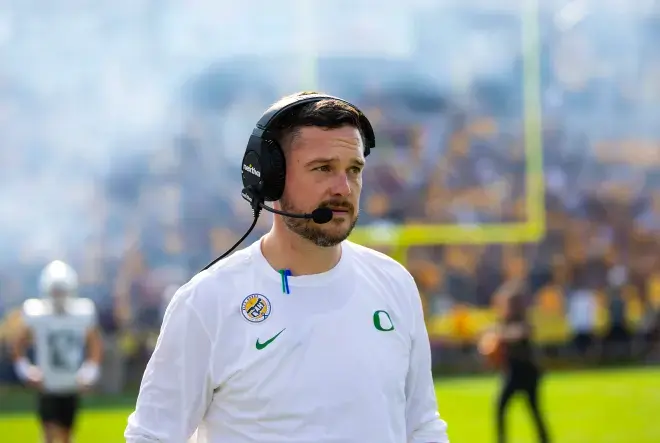
We are already seeing this play out in front of us. Dan Lanning, the head coach of Oregon, was immediately suspected to be the top priority for Alabama. He was a logical first target; Lanning was a GA with the Crimson Tide in 2015, a season that saw Alabama defeat Clemson for Saban’s fifth national title. He since moved on and saw success at Georgia as a defensive coach and then became the head coach of Oregon, leading them to a 22-5 record over the span of the two seasons and winning a bowl game in each. A win in the PAC-12 Championship game this year likely would have landed his Ducks in the playoff. If the playoff had expanded one year earlier, they certainly would have been included. Lanning clearly is building something special in Eugene.
But obviously he would want the Alabama job, right? I mean, it’s Alabama!
Wrong. Lanning officially announced today that he would not be leaving Oregon to replace Nick Saban at Alabama.
Why? Because what would be the motivation? Put aside the fact he would have to try to live up to the impossible standard that Saban has left behind him, but the expansion of the playoff to twelve teams has ensured Lanning – and many of the other coaches on Alabama’s list of targets – that if they believe the good situation they are in will continue into the future, they will have a chance to compete for a national championship.
Jumping ship leaves no guarantee.


Comments